
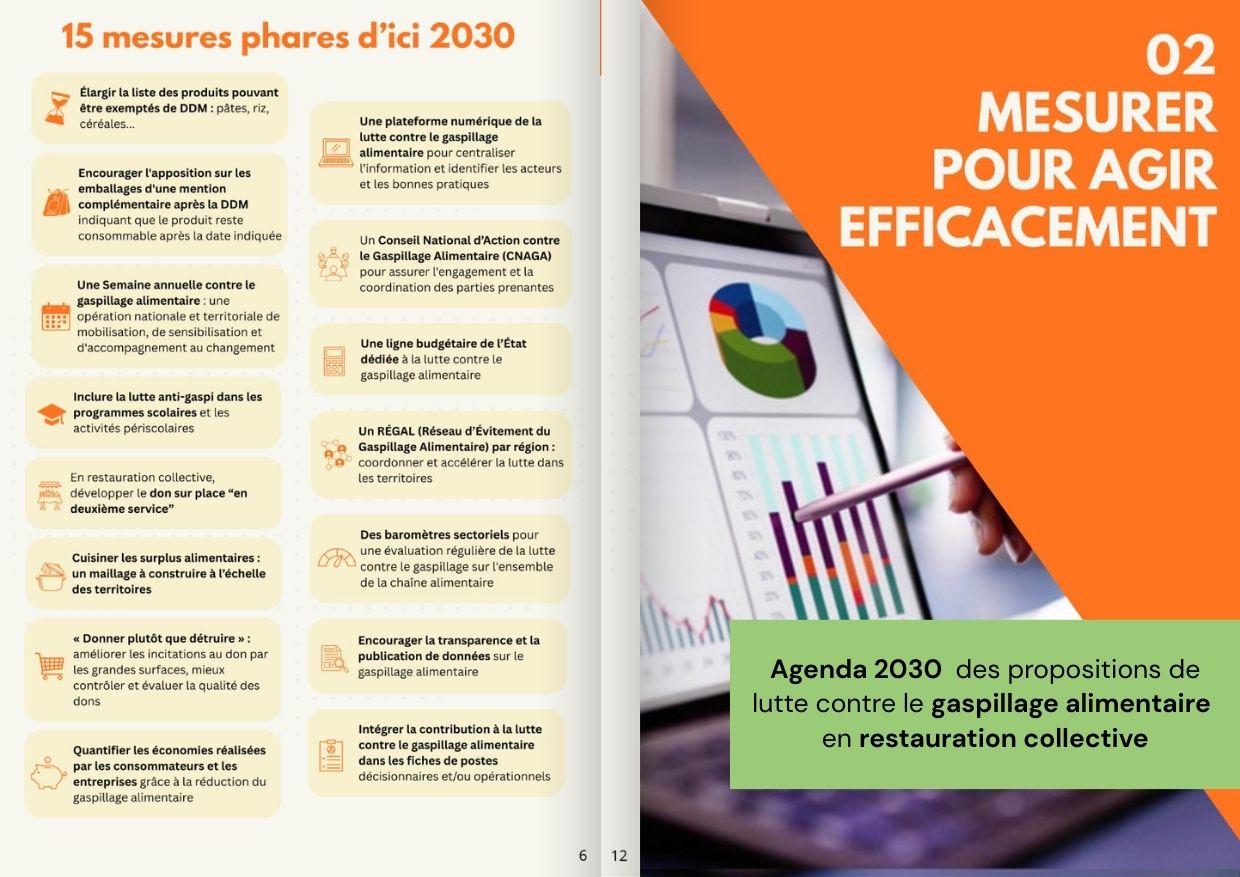

French MPs Guillaume Garot and Graziela Melchior have published *Agenda 2030 – 55 proposals against food waste*, following the national debate on food waste and a decade of mobilisation. The roadmap extends the direction set by the Garot law, EGAlim and the AGEC law.
It does more than repeat the objective of reducing waste and its environmental and economic cost. It changes the logic of the system: collective catering is moving from awareness, to accountability, and increasingly towards measurable evidence.
For healthcare facilities, care homes, senior living, school canteens and public central kitchens, food management becomes a governance and data-management issue.
Why Agenda 2030 matters for collective catering
The roadmap sits within a clear context:
- a national objective to reduce food waste by 50%;
- growing budget pressure on public bodies;
- climate objectives integrated into public policy;
- stronger expectations around transparency and traceability.
It also recognises a practical point: waste in collective catering is often a problem of organisation, portion adjustment and insufficiently precise measurement.
Three structural priorities: measure, inform, organise
1. Measure: moving beyond rough estimates
Many facilities still weigh waste occasionally, use ratios or extrapolate national averages. A more accountable approach requires regular monitoring, traceability over time and the ability to demonstrate progress.
In healthcare and care homes, the challenge is twofold: reduce waste while protecting nutritional intake. Without measuring actual intake, teams cannot know whether portions are appropriate, whether residents are eating what is served or whether an adjustment is working.
In schools, weighing total waste is not enough. Teams need to understand which components are rejected, whether portions are too large and whether seasonality or presentation influences consumption.
2. Inform: making decisions accountable
The second priority is transparency. Facilities will increasingly need indicators, reporting and internal governance around food waste.
That means dashboards, time-based monitoring and decisions that can be explained. In care homes and hospitals this may include the connection between waste and low intake, menu adaptation and coordination between kitchen and care teams. In school catering it can support procurement, budgets and food-policy decisions.
3. Organise: making measurement part of the system
Food-waste reduction should not remain a one-off project, isolated experiment or communication campaign. It needs to be included in public procurement, specifications, internal responsibilities and territorial food policies.
This requires durable tools, not temporary audits.
What changes in practice
| Before | After |
| --- | --- |
| Annual audit | Ongoing monitoring |
| Global weighing | Detailed analysis |
| Awareness campaign | Shared accountability |
| Intention | Evidence |
For healthcare and social-care facilities, food data becomes strategic, waste becomes an operational indicator, and nutrition, economics and environmental responsibility become connected.
For schools, portion adjustment can become an economic lever, data can support food education, and management becomes more precise and defensible.
An opportunity to structure collective food service
Agenda 2030 does not create an immediate obligation for every organisation, but it sets a clear direction. Facilities that anticipate the change can build evidence, improve performance and make better use of their budgets.
Data is no longer just an indicator. It becomes a management tool, a compliance support and a lever for continuous improvement.
Measure. Inform. Organise.
Skeal: an operational response to the 2030 agenda
Skeal supports these three priorities:
- Measure: make actual consumption, leftovers and portion fit visible.
- Inform: provide usable indicators shared by management, kitchen and care teams.
- Organise: integrate meal data into a continuous, structured and documented workflow.
In hospitals, clinics, care homes, senior living and schools, Skeal connects food waste, nutrition and operational performance in one system.
As collective catering moves towards evidence and data-based governance, Skeal helps turn intention into proof and data into action.
Discover Skeal: AI-assisted measurement for collective food service.
Source: publication of the French National Council for Food (CNAGA).